
Gold Mining and Mineral Exploration in Canada
Canada produces about 200 tonnes of gold a year across roughly 60 mineral commodities from 200 active mines. The country sits second worldwide in uranium and niobium, third in palladium, first in potash. Mineral exports hit $153 billion in 2024 – about 21% of Canada’s total goods exports, with more than half flowing south of the border.
This hub covers gold mining and mineral exploration across Canada – what gets pulled out of the ground, where, by whom, and what the junior side of the sector looks like in 2025-2026. The focus is information, not investment advice. Page links lead to deeper reading on Ontario’s gold belts, the Ring of Fire critical minerals district, the rare earth build-out in Saskatchewan and the Northwest Territories, and the past-producing mines coming back online after decades of dormancy.
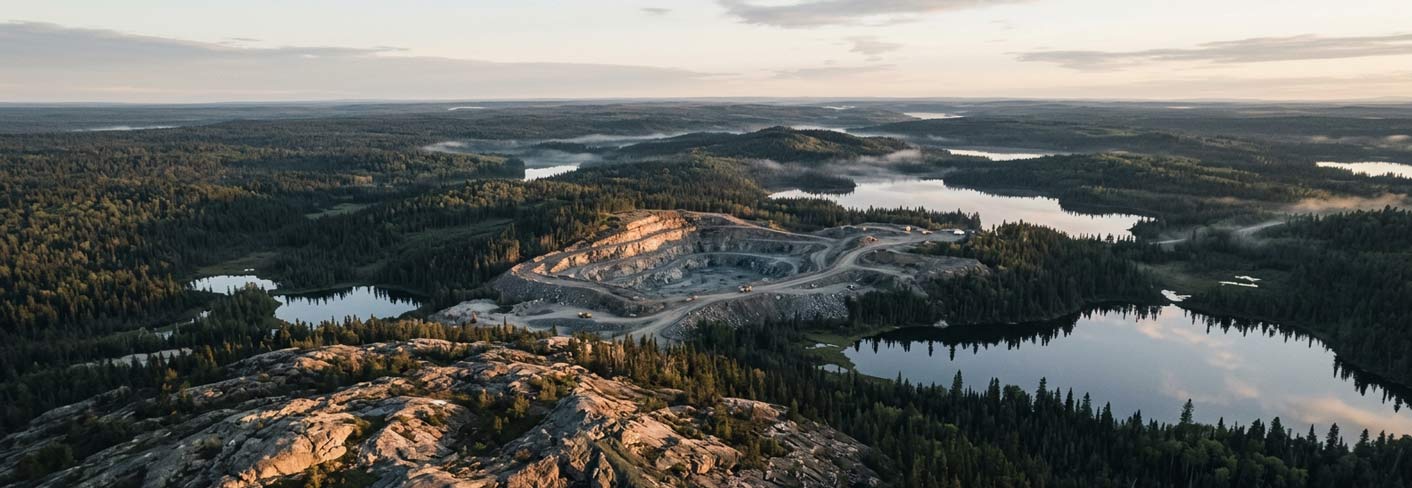
Where Canadian gold actually comes from
Ontario and Quebec dominate national gold output. Northwestern Ontario alone delivered roughly 1.05 million ounces at year-end 2024, and the province’s gold attracted more than $603 million in exploration spending – leading every other commodity in Ontario by a wide margin. Quebec’s Abitibi belt, British Columbia’s Golden Triangle, and Nunavut’s Hope Bay round out the top contributors.
The geography is straightforward: gold sits where the Canadian Shield is exposed, and the Shield runs through Ontario, Quebec, Manitoba, Saskatchewan, the Northwest Territories and Nunavut. Most of the country’s historic and current gold production traces back to Archean greenstone belts – Abitibi, Red Lake, Wabigoon, Birch-Uchi – formed roughly 2.7 billion years ago.
| Region | Notable producing mines (2025) | Approx. annual output |
|---|---|---|
| Northwestern Ontario | Red Lake, Musselwhite, Hemlo, Rainy River, Greenstone, Island Gold | ~1.05 Moz |
| Northeastern Ontario | Detour Lake, Macassa, Young-Davidson, Magino | ~1.0 Moz |
| Quebec (Abitibi) | Canadian Malartic, LaRonde, Eleonore | ~1.5 Moz |
| British Columbia | Brucejack, Red Chris, Mount Milligan | ~0.6 Moz |
| Nunavut | Meliadine, Meadowbank, Hope Bay | ~0.5 Moz |
The producers, the developers, the explorers
Three tiers run the sector. At the top are major producers – Agnico Eagle, Newmont, Barrick, Kinross, Alamos, Wesdome – with multiple operating mines, dividends, and market caps in the tens of billions. The middle tier holds developers transitioning from exploration to production. And below them sit several hundred junior explorers listed mainly on the TSX Venture Exchange and the Canadian Securities Exchange (CSE).
The 2025 numbers tell the story of a strong year for the sector. Junior miners accounted for 51% of Canada’s $4.2 billion in mineral exploration spending. The TSX Venture 50 list – companies with the highest share-price gains over the year – was dominated by mining: 48 of 50 spots, with average share-price gains of 443%.
“As companies progress through planning, they are not betting on the gold price staying where it is at the moment. Most companies are remaining pragmatic around new investments in gold whilst still enjoying the benefits of rising prices.”
– Ben Charles, Partner, Bain & Company (Ontario Mining 2025 report)
Critical minerals are reshaping the conversation
Gold is still the headline metal, but federal and provincial policy now treats critical minerals – copper, nickel, lithium, cobalt, graphite, rare earth elements – as the strategic priority. Canada’s Critical Minerals List ran 31 minerals in 2021. The 2024 update added high-purity iron, phosphorus and silicon metal, bringing the total to 34. Ottawa committed nearly $4 billion to the Strategy in Budget 2022 and another $1.5 billion through the First and Last Mile Fund in Budget 2025.
In October 2025, under the country’s G7 Presidency, Canada announced over 20 new investments and partnerships totalling $6.4 billion in critical mineral projects. The same year, the federal government designated certain critical minerals as a national security priority under the Defence Production Act, opening the door to stockpiling and offtake agreements. Two were signed early – with Rio Tinto for scandium and with Nouveau Monde Graphite.
What changed in 2025-2026
- Hemlo changed hands. In November 2025, Carcetti Capital acquired Barrick’s Hemlo gold mine for up to US$1.1 billion, rebranding as Hemlo Mining Corp. (TSXV: HMMC). Full-year 2025 production: 143,458 ounces – the highest from the camp in four years.
- Madsen reopened. West Red Lake Gold (TSXV: WRLG) achieved commercial production at the Madsen mine on January 1, 2026 – seven months after completing its bulk sample, with December 2025 mill recoveries averaging 94.6%.
- Newmont divested. Newmont sold Musselwhite, Eleonore and Cripple Creek for $1.7 billion in March 2025, then Akyem and Porcupine for $850 million in April. Total divestiture: $4.3 billion to focus on 10 top-tier mines.
- Equinox absorbed Calibre. The February 2025 merger created Canada’s soon-to-be second-largest gold producer, with Greenstone targeting 300,000-350,000 ounces annually and Valentine (Newfoundland) coming into the fold.
- Hemlo’s acquisition price set a marker. At US$1.1 billion for an asset producing ~143,000 oz/year, the M&A market priced cash-flowing Canadian gold mines at roughly $7,700 per annual ounce – a premium tied to gold trading near US$4,150/oz in Q4 2025.
Recent news across the Canadian mining sector
Most Canadian mining coverage breaks down by commodity. The sub-sections below summarise where each commodity stream sits as of early 2026.
Rare earths news
Saskatchewan Research Council’s commercial NdPr facility moved through hydrometallurgy and metal smelting stages in 2024-2025; commercial ramp targets 400-600 t/year by 2027. Vital Metals updated its Tardiff resource to 192.7 Mt at 1.3% TREO in January 2025.
Uranium news
Saskatchewan’s Athabasca Basin remains the global high-grade uranium hub. NexGen Energy’s Rook I project advanced through federal licensing in 2025; Denison Mines’ Wheeler River Phoenix project completed final feasibility updates.
Copper news
Sterling Metals’ Soo Copper Project north of Sault Ste. Marie pulled 262.5 m at 1.05% CuEq in September 2025. Ivanhoe Mines, Hudbay Minerals and Capstone Copper continued to dominate the Canadian-listed copper producer tier.
Iron ore news
High-purity iron ore was added to Canada’s 2024 critical minerals list, reframing several Quebec-Labrador projects as strategic assets rather than commodity plays.
Lithium news today
Sayona Mining’s North American Lithium operation in Quebec restarted in 2023 and ramped through 2025. Frontier Lithium’s PAK Project in Ontario was selected for the One Project, One Process framework.
Graphite news
Nouveau Monde Graphite signed an offtake agreement with the federal government under the Defence Production Act designation in 2025 – one of two early offtake commitments alongside Rio Tinto for scandium.
For sector-wide coverage outside Canada, the Mining Journal and mining.com remain the primary trade publications.
How the sector is structured
Anyone trying to understand Canadian mining for the first time runs into a tangle of acronyms – TSX, TSXV, CSE, NI 43-101, PEA, PFS, DFS. Here’s the short version. Canadian junior miners list mainly on the TSX Venture Exchange (TSXV) or the Canadian Securities Exchange (CSE). Both are designed for early-stage companies; the CSE is the more permissive of the two and tends to host smaller exploration-stage names. NI 43-101 is the Canadian standard for public disclosure of mineral project information – every resource estimate, drill result and feasibility study has to be signed off by a Qualified Person under that standard.
| Term | What it actually means |
|---|---|
| NI 43-101 | Canadian Securities Administrators standard governing disclosure of scientific and technical mineral project information. |
| PEA | Preliminary Economic Assessment – first-pass economics on a project, often based on inferred resources. |
| PFS | Pre-Feasibility Study – bankable economics with engineering and an indicated resource. |
| DFS | Definitive (Bankable) Feasibility Study – final-stage assessment used to secure construction financing. |
| Flow-through shares | Tax structure letting Canadian explorers pass exploration deductions to investors. Provided ~75% of junior exploration capital in 2024. |
| METC | Mineral Exploration Tax Credit – federal credit on grass-roots exploration; 30% for critical-mineral projects through 2027. |
Reading further
This site organises Canadian mining content by topic. Pages worth starting with:
- Junior mining companies in Canada – how the sector is structured, who finances it, what makes a junior different from a major
- Past-producing gold mines in Ontario – the wave of mine restarts including Madsen, Hemlo and others
- Ring of Fire mining – Ontario’s remote critical minerals district and what’s changed since 2025 legislation
- Rare earth metals in Canada – the SRC processing facility, Nechalacho, Strange Lake and the path to non-Chinese supply
- Critical minerals strategy – the 34-mineral list, federal funding, and what counts as critical and why
- Gold properties and mining claims in Ontario – how claim staking works, where the active areas are
- Critical metals at Sault Ste. Marie – the Batchawana Greenstone Belt copper-gold story
Source notes
Production figures cited above draw on Natural Resources Canada Annual Mineral Exploration and Deposit Appraisal data, Ontario Ministry of Mines disclosures, and individual company NI 43-101 reports. M&A figures come from public filings and SEDAR+ disclosures. Critical Minerals Strategy details are from Canada.ca and the Canadian Critical Minerals Strategy Annual Report 2024 and Progress Update 2026.
Information here is for general reference. Anyone making investment decisions should read the underlying technical reports and consult a licensed advisor.
About this resource
This website operates as an independent informational resource focused on the Canadian mining sector.
The domain was previously associated with Advance United Holdings, a company involved in gold exploration in Canada. The current website is not affiliated with, endorsed by, or connected to that organization in any way.